The Hybrid Resin Making System
A water-based mineral casting material, matched with the molds, pigments and sealers that make it work. Pick the look you want and we'll show you everything it takes.
- Easy flow
- Demolds in about 20 minutes
- Water-based
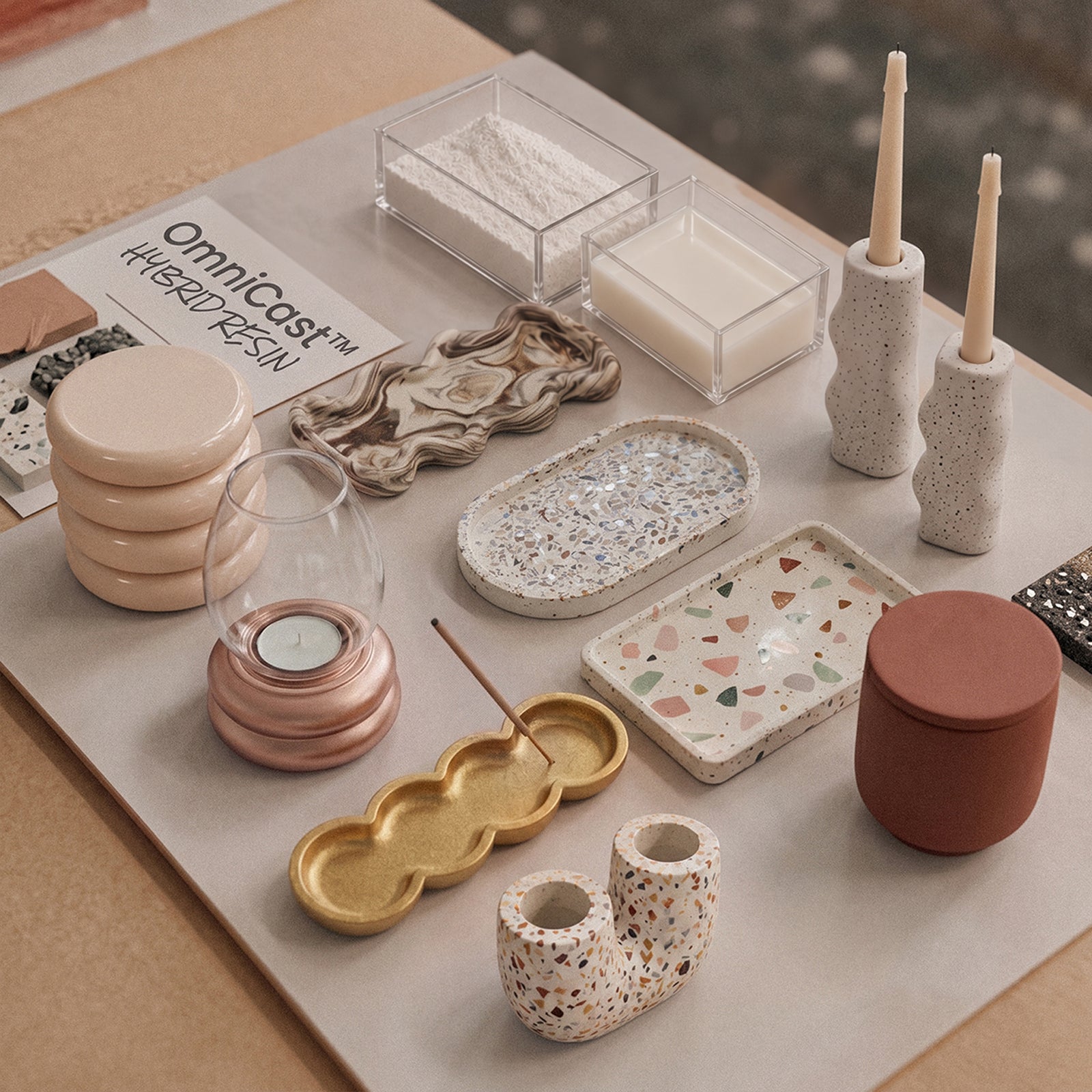
What Hybrid Resin does well
Capta detalhes finos
Flui suavemente para moldes detalhados com o mínimo de bolhas.
Realmente captura as cores
Mostra as cores de pigmentos e pastas como elas são, de tons sólidos a mármore e granilite.
Leve e difícil
Mais leve que o gesso, mais resistente ao desgaste e menos propenso a lascar.
Desenforme em 20 minutos
Endurece rapidamente, para que você possa desenformar em cerca de 20 minutos e fazer outra mistura. Ideal para produções em estúdio e aulas.
À base de água, com pouco odor
Sem solventes agressivos nem cheiro persistente depois de seco, para que você possa trabalhar em casa ou em uma sala de aula.
Finaliza suavemente
Lixa, pinta, lustra, sela ou encera com facilidade.
Choose a look, get the full list
Every look below lists exactly what it takes. Untick what you already own and add the rest in one click.
Cor sólida
Uma cor, uma camada. A primeira peça mais fácil.
Gradiente
Dois pigmentos, aplicados em camadas para criar um degradê suave.
Mármore
Algumas gotas de preto, incorporadas sem misturar completamente.
Granilite
Misture as lascas, despeje, depois lixe para revelá-las.
Metálico
Despeje em um molde liso e depois aplique um acabamento brilhante com mica usando um pincel.
Choose by your stage
Dois kits para criadores, cada um com um brinde grátis para quem comprar antecipadamente. Estúdios que comprarem 16 kg podem fazer pedidos no atacado.

Iniciante — 1.6 kg
1.200 g de pó + 400 g de líquido
Boa primeira opção: Cor sólida


Estúdio — 16 kg
12.000 g de pó + 4.000 g de líquido
Apenas para atacadoFeito para: aulas e produção em pequenos lotes
Before you start
Still have a question?
Ask us about Hybrid Resin. Leave your email so we can get back to you.
What is Hybrid Resin, and what can I make with it?
A two-part casting system made from a mineral-based powder and a water-based polymer liquid. Use it for decorative trays, vessels, homeware and craft objects, with pigments and finishes for solid colors, gradients, marble, terrazzo and metallic effects.
What is the mixing ratio?
Mix 3 parts powder to 1 part liquid by weight — for example, 300 g powder with 100 g liquid. Shake the liquid thoroughly before measuring, then mix the powder, liquid and colorant thoroughly. Start with a small test batch before making larger quantities.
Can I adjust the mixture for better flow or strength?
Start with the 3:1 powder-to-liquid ratio. For complex or highly detailed molds, the product sheet allows 3–5% more liquid than the base amount. For simple, easy-to-pour shapes where strength is the priority, it allows 3–9% less liquid than the base amount. Test a small batch before production.
How soon can I demold my piece?
The mixing instructions give an initial set of approximately 5 minutes and a demolding time of around 15–20 minutes. Start with a small batch to check the material and result before moving into repeat production.
Why is my casting soft, fragile or powdery?
Inaccurate proportions can leave a piece soft, fragile, uncured or powdery on the surface. Check that you measured by weight, shook the liquid before use and mixed all components thoroughly. Insufficient mixing can also cause color spots, bubbles or uneven curing.
Do I need to seal my pieces?
Sealing is recommended. Unsealed surfaces can absorb water or oil, stain and scratch more easily. The cured surface can be sanded, polished, painted, sealed, varnished or waxed to create the finish you want.
Is it suitable for direct food contact?
It is a decorative craft material and is not recommended for direct food contact. The product sheet calls for a professional food-contact-safe sealer for any such use; the finished application must also be separately validated. The SDSs and chemical test reports below are not food-contact approvals.
Does it have a strong smell?
The product sheet describes the system as water-based and low odor. The powder SDS describes the powder as odorless, while the liquid SDS records a slightly pungent odor. Work in a well-ventilated area.
What precautions should I take while working?
Avoid breathing powder dust and avoid eye contact. Work with good ventilation and follow the relevant component SDS for protective equipment. The powder SDS recommends eye protection where dust may be generated, protective gloves and suitable clothing, with suitable particulate respiratory protection where ventilation is inadequate or exposure limits may be exceeded.
How do I clean up?
Do not pour leftover material or cleaning wastewater down the drain — it may harden and block pipes. Keep the powder and liquid out of drains and waterways, and follow the disposal guidance in their SDSs.
How should I store the powder and liquid?
Keep the powder tightly sealed and dry, and recap the liquid promptly after use. Store in a cool, dry, well-ventilated place at 5–35°C, away from direct sunlight, high temperatures and freezing. Shake the liquid thoroughly if slight sediment appears after storage.
Can children use it?
Children should use this craft material only under adult supervision. It is not recommended for children under 3 years old. Do not swallow it or allow direct contact with food; the powder SDS does not recommend children's toy uses unless separately validated.
For studios and shops
Fixed ratio, fast demold and repeatable results make Hybrid Resin a fit for classes and small-batch production. Become a BN distributor for wholesale pricing.
Safety data & test reports
Read the component safety information and download the full chemical test reports.
Powder base · Safety Data Sheet
Handling, storage, exposure controls and disposal for the powder base component.
PDF · 12 pages · 96 KBOpen PDF Safety Data SheetPolymer liquid · Safety Data Sheet
Safety information for the OmniCast Hybrid Resin polymer liquid component.
PDF · 12 pages · 808 KBOpen PDF Chemical test reportREACH SVHC · Chemical test report
SVHC testing of the submitted powder and liquid samples against the list stated in the report.
PDF · 15 pages · 1180 KBOpen PDF Chemical test reportHexavalent chromium · Chemical test report
Hexavalent chromium (Cr VI) test results for the submitted powder and liquid samples.
PDF · 2 pages · 606 KBOpen PDFSDSs cover the individual components. Test results apply to the samples tested. These documents are not food-contact approvals.